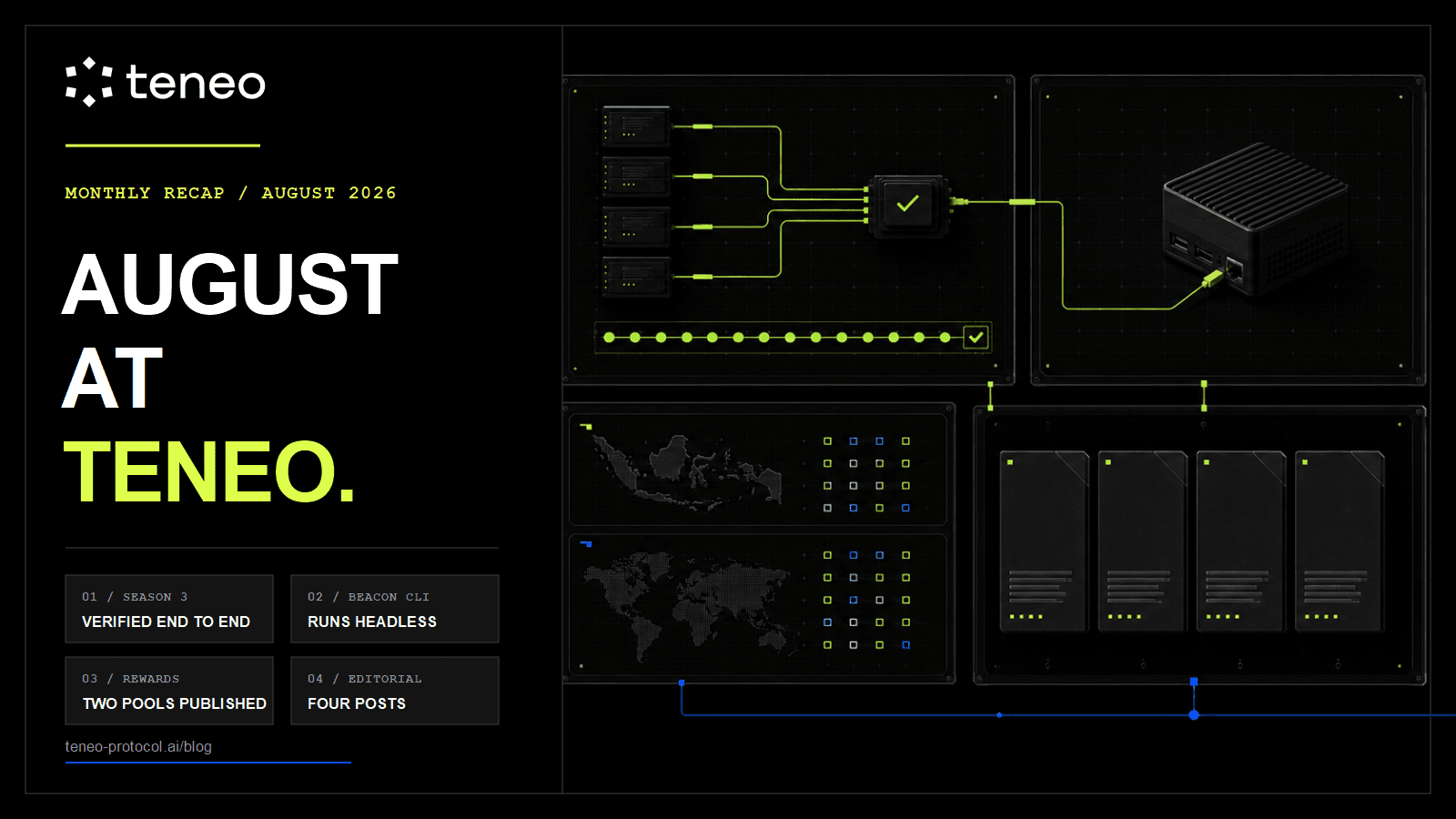
August made the network easier to leave running. Season 3 closed verified end to end, the Beacon picked up a headless CLI for hardware you already own, the Season 3 reward pools were published with one corrected number, and four posts ran as one argument.
July made the network harder to fake. August made it easier to leave running.
Season 3 closed as the first season verified end to end, and the Beacon itself picked up a version that does not need a desktop at all. If you have a Raspberry Pi or an old laptop gathering dust, that second one is the change worth acting on this week.
Here is the month.
Season 3 closed as the first verified season
Season 3 ran 60 days and ended on 30 August.
What made it different from Seasons 1 and 2 was running underneath it the whole time. The network sent small connection checks to each Beacon to confirm a genuine connection, which kept fake residential IPs and bot accounts off the board. Every previous leaderboard asked you to take it on trust that the accounts above you were real. This one did not.
The draw is being finalised from everyone who kept a Beacon running through the season. There is nothing to enter and nothing to claim. If your Beacon was online, you are already in it.
Winner cards follow once the draw settles, and the payout wallet is confirmed on the card at the moment you win rather than in a form you filled in months earlier. That is the reason payouts land where they should.
Between seasons, the Beacon keeps counting
A season closing does not switch anything off. Your Beacon carries on collecting Fragments whenever it is online, and that is worth saying plainly, because the most common reason a good operator drops down a board is a gap between one season closing and the next one starting.
Uptime is the only variable you control, and it is the one that carries across seasons. When the next season opens, the details will be on the official channels, and the operators who kept running through the gap arrive with their uptime intact.
The Beacon now runs headless
This is the biggest product change of the month.
The Teneo Beacon runs from a terminal. One command installs it, you pair it by scanning a QR code while signed in to the Hub, and installing it as a service means it starts on boot and reconnects after an outage without anyone watching it.
That turns hardware you already own into an always-on node. A Raspberry Pi, a home server, a NAS, an old laptop with a broken screen. None of it needs a desktop session or a browser window left open.
One limit matters and it has not changed. Earning is one slot per internet connection, not per device. Two Beacons on the same home network do not stack. What the CLI does is let a low-power machine hold that slot around the clock instead of a laptop that sleeps when you close the lid.
Reward pools, and a number we corrected
On 27 August we published how the Season 3 reward pool splits, along with one change nobody enjoys making.
$1,000 USDC is reserved for Beacon runners on Indonesian IPs. Eligibility is tied to a genuine connection in Indonesia, and your share is set by uptime. $1,000 USDC goes across all Beacon runners wherever they are, Indonesia included.
The correction: payouts can take up to seven business days to arrive after you confirm your wallet on the winner card. We had been publishing 72 hours. That figure was tighter than settlement actually runs, so we replaced it with the real window rather than keep quoting a fast one we miss.
The Indonesia pool is still the deliberate regional test it was in July. Concentrate a pool in one region, measure what real uptime looks like there, then decide whether to run it elsewhere. It only works because Season 3 shipped the verification that makes "a genuine connection in Indonesia" a checkable claim rather than a hopeful one.
Boost cycles, for anyone who has never touched one
A reminder that went out on 25 August and is worth repeating in a round-up, because it is the cheapest thing an operator can do.
Boost every eight hours. Beacon Power builds towards 3.00x. If you installed the Beacon and never opened it again, that multiplier is sitting there unused, and uptime is the thing it multiplies.
What we published
Four posts in August, and they run as one argument rather than four separate ones.
- DePIN outgrew oracles this year. Here is the map, and where your Beacon sits on it breaks DePIN into the five different physical resources it actually is: compute, storage, wireless, sensors and mapping, and data infrastructure. The Beacon sits in the fifth column, and the map explains why that column is the hardest one to assemble.
- Inference Got Cheap. Data Did Not. is the argument underneath everything else we shipped this month. When compute stops being the constraint, whatever is left becomes the constraint. For agents doing real work, that is access to the live public web.
- Agentic AI Infrastructure Is Leaving the Chat Window covers what changes when agents stop being things you talk to and start being things that run.
- Agents Got Wallets. Now They're Getting Counterparties. asks who is on the other side of the trade once everyone agrees the agent economy exists. The answer, increasingly, is other agents.
Read in order, they land on one point. The bottleneck moved from thinking to knowing, and knowing is supplied by connections in real places.
Three ways onto the network
For builders, the install surface widened rather than changed.
The Teneo CLI speaks MCP, so it drops into whatever you are already running: Claude Code, Cursor, a plain terminal, a self-hosted gateway, a standalone runtime. Behind it sit hundreds of live agents covering market data, on-chain analytics and public web data in real time. You pay per call in USDC over x402, with no API key, no subscription and no seat.
If you would rather not touch a terminal, the Agent Console does the same job in a browser. And the headless CLI covered above is the third surface, for anyone who wants a node up permanently on low-power hardware.
Same protocol, same agents, same per-query pricing across all three.
Into September
The Season 3 draw settles first, and winner cards follow it. The Beacon CLI means the cheapest way to hold uptime through whatever September brings is a device you already own and never look at.
If your Beacon is not running, that is still the one thing worth fixing today.
Key takeaways
- -monthly recap
- -Season 3
- -Beacon CLI
- -headless node
- -reward pools