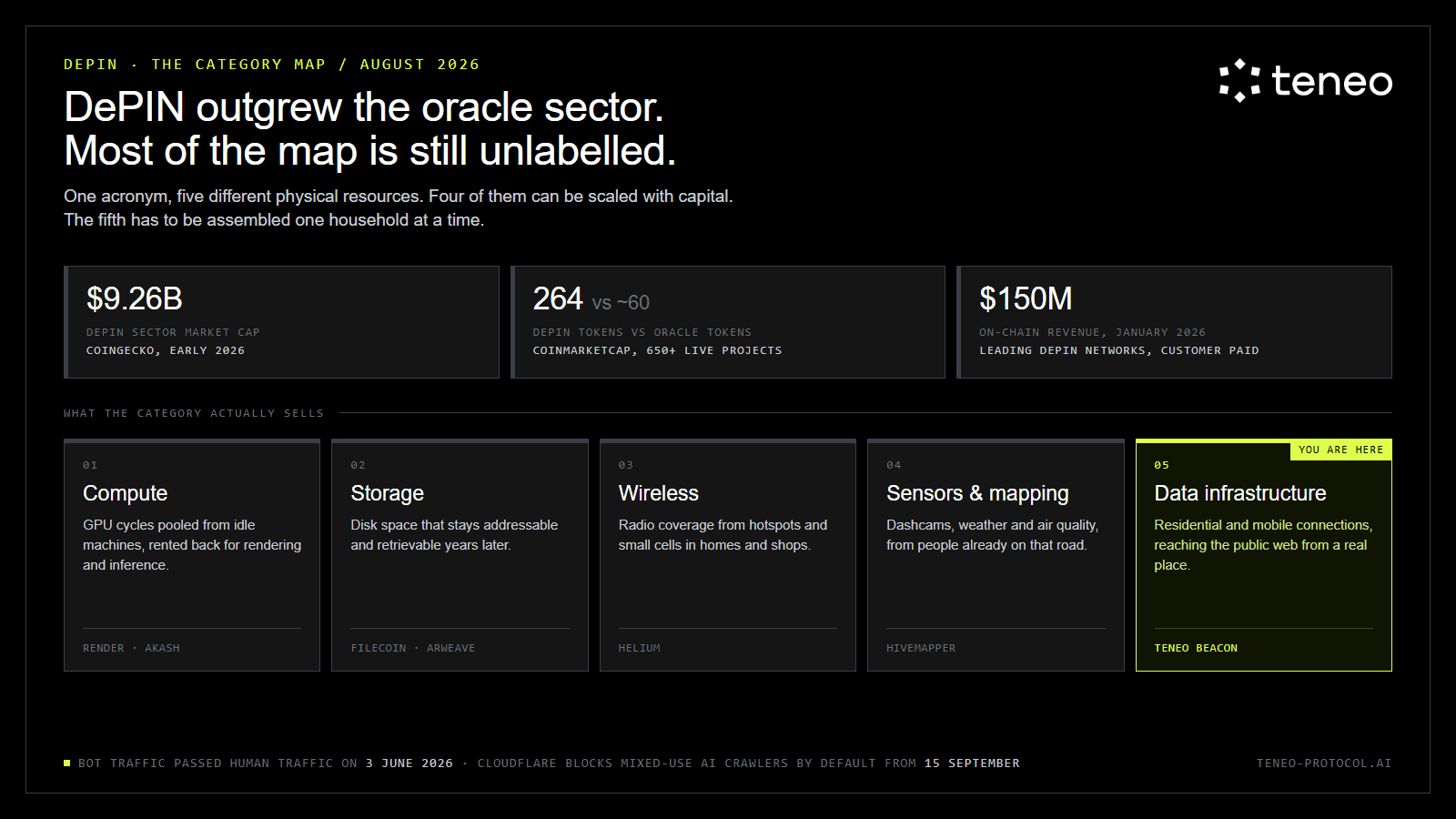
DePIN passed the oracle sector in combined market cap this year, across more than 650 live projects. Most crypto portfolios have not caught up, and most of the vocabulary has not either. This is the category map: what DePIN covers, the five resources it splits into, and which one Teneo Beacon supplies.
Somewhere in the first half of 2026, decentralised physical infrastructure passed the oracle sector in combined market cap. CoinMarketCap tracks 264 DePIN tokens; CoinGecko puts the sector's combined value near $9.26 billion. The oracle category it overtook holds about 60 tokens, Chainlink included. Messari counts more than 650 live DePIN projects. In January alone, the leading networks booked around $150 million in on-chain revenue from customers paying for output.
Now ask a crypto-native user to name five DePIN projects. Most stall at three.
The gap is not a knowledge problem, it is a naming problem. DePIN gets used as if it labels one thing. It labels at least five, and they have almost nothing in common except the payment model.
What DePIN actually is
A DePIN network pays ordinary people to supply a physical resource, then sells the aggregate to someone who needs it.
Both halves have to be there. A network that pays for a resource nobody buys is a rewards programme with extra steps. A network that sells a resource it sources centrally is a company with a token attached. DePIN is the case where supply is distributed across real people and real hardware, coordinated by a protocol, and the output has a buyer on the other side.
The resource is what splits the category. Get that wrong and every project in the sector looks interchangeable, which is exactly why most people cannot name five.
The five things DePIN actually sells
Compute. GPU cycles pooled from idle machines and rented back for rendering and model inference. The recognisable names are Render and Akash. Buyers are studios and AI teams who want capacity without a cloud contract.
Storage. Disk space that is addressable and retrievable years later. Filecoin and Arweave. Buyers are archives, datasets, and anything that needs to outlive the company that made it.
Wireless. Radio coverage supplied by hotspots and small cells in people's homes and shops. Helium is the canonical case. The buyer is a carrier or a device fleet that needs coverage where the incumbent has none.
Sensors and mapping. Dashcams, weather stations, air-quality monitors, contributed by people who already drive that road or live on that street. Hivemapper is the clearest example. Buyers are logistics, insurance, and mapping companies.
Data infrastructure. Residential and mobile internet connections, contributed by the people already paying for them, used to reach the public web from a real place. This is the slice with the fewest household names and the most direct exposure to what AI is currently short of. Teneo Beacon is here.
Four of those five sell a resource that existed as a product before crypto did. Storage, compute, coverage and sensor data all had incumbent markets to undercut. The fifth is different, and 2026 is the year it became obvious why.
Why the data slice changed this year
On 3 June, Cloudflare's CEO reported that automated traffic had passed human traffic on the open web for the first time: 57.5% of HTTP requests against 42.5% from people. Most of that growth is agents fetching pages in real time on behalf of a user, not crawlers reading the archive.
Those agents can now pay for anything. There were 165 million x402 transactions across roughly 69,000 active agents by late April, and Coinbase has since packaged the rail into a three-line install. Payments, custody, chains and dispute resolution for agents all standardised inside about eight weeks.
None of it lets an agent read a page that does not want to be read. And the web is closing, not opening: from 15 September Cloudflare blocks mixed-use AI crawlers by default on ad-supported pages. Cloudflare sits in front of more than a fifth of global web traffic.
Data centre IP ranges are the first thing a bot filter blocks, and they get blocked more every quarter. A request from a real residential connection in the country whose results you actually want is not a workaround. In a lot of cases it is now the only way to see the page a local user sees. That is a physical resource, it cannot be written as a spec, and it is the one an agent stack cannot substitute its way out of.
DePIN 1.0 and DePIN 2.0
There is a second split inside the category, and it matters more than the sub-sector for anyone actually holding supply.
DePIN 1.0 decentralises the supply side of a resource and sells the output into the same market the centralised incumbent serves. It works, and it has a ceiling: you compete on price with an incumbent, and once supply runs ahead of demand, rewards dilute and operators leave.
DePIN 2.0 supplies the primitive and owns the demand layer that consumes it. Both sides sit inside the same protocol. That is the reason Beacon is built the way it is: hundreds of agents run on the Teneo CLI and Go SDK, each with on-chain identity, each charging per query in USDC over x402 across peaq, Base, Avalanche, BNB Chain and X Layer. The buyer of live web access and the network supplying it are the same protocol.
That is the structural claim. Here is the machinery under it.
Where your Beacon actually sits
The device. Beacon is a native app on Windows, macOS, Linux, Android and iOS. It is Community Node 2.0, built in-house to replace the browser extension, which is why it holds a connection properly instead of depending on a tab staying open. It shares unused bandwidth and runs in the background.
The verification gate. The network sends small tasks to confirm a node is a genuine connection, which filters bots and spoofed residential IPs. Earning is gated by unique public IP, not by device: one earning slot per internet connection, so five machines on the same Wi-Fi do not stack. This is the least popular design decision in the whole system and the one that makes the supply worth buying. A network that pays for duplicate IPs is selling its customers the same connection five times.
The network. Verified nodes have passed 7,000 as of the 2 July all-hands, drawn from a community of 6.5 million participants across 192 countries recorded in April. Those two numbers measure different things and should not be added together: the first counts connections proven real, the second counts people who have joined. Season length was extended to 60 days to keep bot farms from inflating counts.
The access layer. What the network supplies is the ability to reach public pages across X, Reddit, TikTok, LinkedIn, Instagram, YouTube, Google Maps, Google Search and Yelp, from a real place, seeing what a local user sees. Local search results and local pricing genuinely differ by country, and that difference is the product.
The agent layer above it. Hundreds of agents are deployed on the protocol with their own wallets and on-chain identity, charging per query. The access layer and the agent layer are converging by design. That convergence is the direction of the architecture, not a description of today's routing.
Your rewards, separately. Points accrue on a heartbeat while the node is connected. Fragments accrue at 10 per unique IP per hour and are claimed on an eight-hour boost cycle, with Beacon Power growing on consecutive boosts up to 3.00x and decaying if you miss the window. Uptime is what the network verifies and what the reward system pays for. Points and Fragments are beta rewards with no conversion rate.
What this is worth to an operator
The daily reward is the part of Beacon you can see. The position is the part you cannot.
Running a node is a supply position in the DePIN sub-sector with the fewest established names, in the year the resource it supplies became structurally scarce. That is not a price prediction and it should not be read as one. It is a statement about which of the five columns your device is in, and the honest read is that the data infrastructure column is the least crowded and the hardest to build, because you cannot spin it up in a data centre. It has to be assembled one household at a time.
Which is the part worth sitting with. Compute, storage, coverage and sensors can all be scaled by capital: buy the GPUs, buy the drives, buy the hotspots. Residential web access is the one resource in the category that capital alone cannot assemble, because the supply is people deciding to leave something running. That makes it slow to build and correspondingly hard to copy, and it is why the count that matters on this network is verified connections rather than registered users.
Your Beacon is already in this category. Now you can see which column.
Key takeaways
- -DePIN
- -Teneo Beacon
- -web access
- -node operators
- -x402