

A local check records what appeared under one set of conditions. Location, device, language and collection method matter; campaign-wide delivery still needs suitable measurement. Teneo Beacon contributes distributed bandwidth to the network.
Ad verification checks whether an advert appeared under the conditions a campaign intended. Location matters because a campaign aimed at people in Madrid may produce a different result from a check made in Paris. Device, language and the time of the check also belong in the evidence. A local observation helps answer what appeared in one context; it does not establish what every person in that market saw.
That creates a practical business need: collect comparable evidence from the markets a campaign serves, then investigate mismatches. Teneo Beacon contributes unused internet bandwidth to the Teneo network. This article explains why distributed connections matter to that work, and which conclusions still require campaign reports or specialist measurement.
What does an ad-verification check need to answer?
A useful check starts with a specific campaign requirement. Was the correct creative available in the intended market? Did its landing page use the expected language? Did the offer remain consistent after the page loaded on a phone? These are different questions, so the evidence should say which one it addresses.
For a public-page observation, retain the page address, time, intended market, observed connection location, device settings and language. Record whether the collection captured only the page response or a rendered page with its visible content. Where a consent choice affects rendering, record the test's consent state too. Without that context, two captures can look contradictory while both accurately describe different conditions.
These fields are a suggested audit record, not a list of outputs promised by a Teneo agent. A buyer needs to confirm the collection method and available fields before designing a test around them.
Why can the same campaign produce different local results?
Advertising systems use more than a country label. Google documents a distinction between someone's physical location and their interest in a location. Its location signals can include the connection address, device location and activity. It also warns that location targeting is not completely accurate in every situation. A location written into a test plan therefore needs evidence behind it. Google Ads: geographic targeting.
The first operational consequence is simple: a request made elsewhere cannot, on its own, establish what appeared in the target market. The second is that moving the connection is only one part of the test. A desktop browser using French and a mobile browser using Spanish are different contexts even when they visit the same URL.
Campaign settings can also include people interested in a place, rather than only people physically there. Before calling a result a geographic mismatch, check the campaign's actual location option. A result outside the service area may be consistent with the selected targeting. Google Ads: advanced location options.
An example: checking a Madrid campaign from two markets
Suppose an advertiser wants to check a Spanish-language offer intended for Madrid. The following is an illustrative test plan, not a report from Teneo or a real campaign.
Start with a Madrid check using a mobile browser and Spanish language settings. Add a Paris check using a desktop browser and French settings as a comparison. Keep the URL and collection window recorded for both. This initial pair can reveal a difference, but it cannot tell you which changed variable caused it.
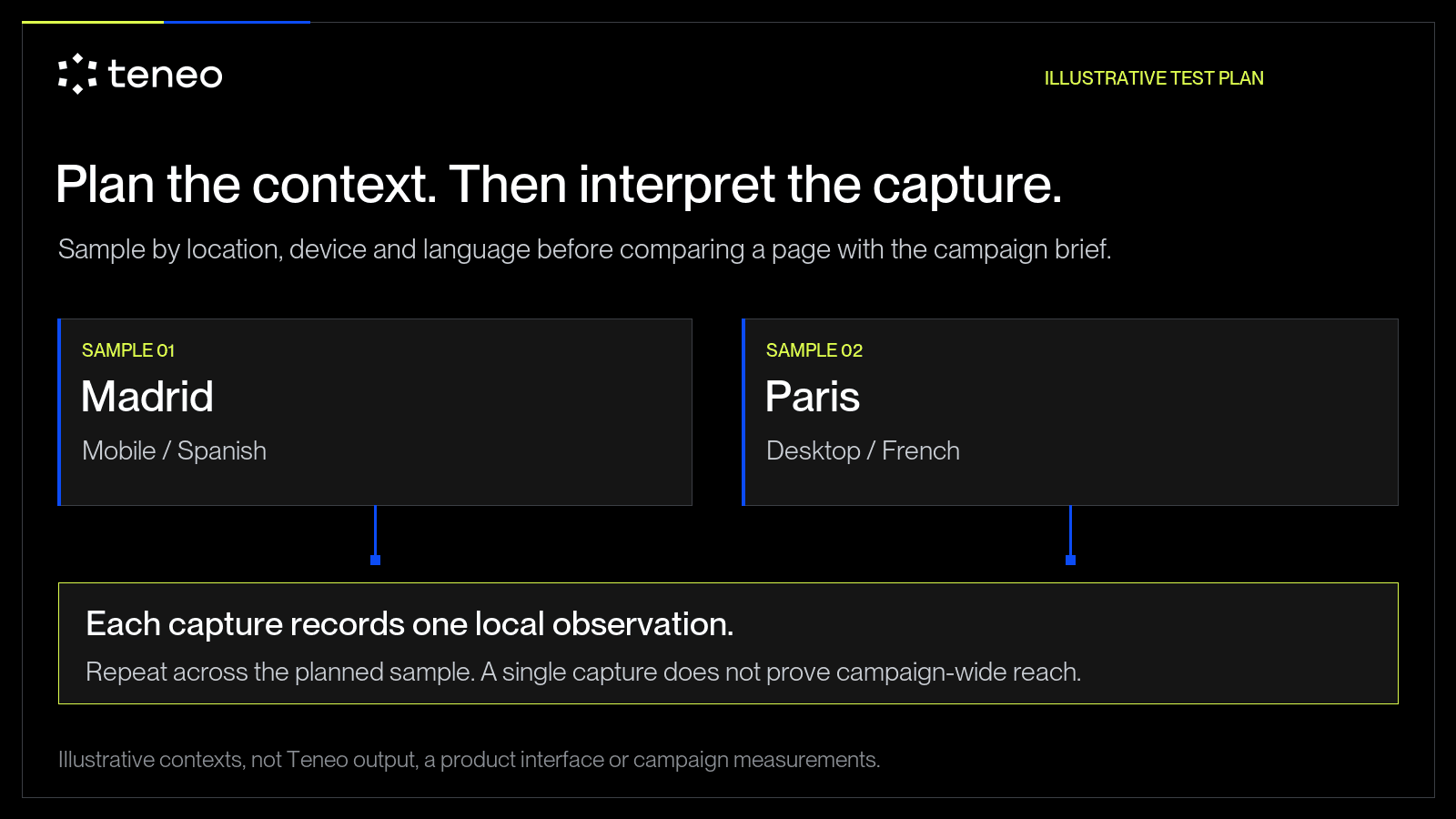
If the landing page differs, repeat the test while changing one condition at a time. Keep the device and language the same while comparing locations. Then hold location and language constant while comparing devices. Record missing ads and failed page loads as observations rather than turning them into a verdict that the campaign failed.
The business decision comes after that investigation. A wrong-language landing page may require a page-routing fix. A difference caused by campaign targeting may require a settings change. A collection failure may require a different evidence method. Each action needs a different diagnosis.
Preview, observation and viewability are different evidence
For your own Google search ads, the platform's Ad Preview and Diagnosis tool is a sensible first step. Google says it can help check an ad's appearance and investigate why an ad or asset is missing without adding impressions through repeated searches. Google also notes that the tool may not reflect all campaign activity. A preview is useful diagnostic evidence, with that limit attached. Google Ads: preview and diagnosis.
A public-page capture answers a separate question: what did this collection process obtain under these recorded conditions? If a page loads an advert through browser scripts, a raw page response may omit the rendered advert. The buyer must check what the collection actually observes before relying on it.
Viewability asks whether an impression had an opportunity to be seen. It is a measurement question, rather than a conclusion available from an isolated retrieved page. IAB UK's explanation makes that distinction explicit. A capture containing a creative does not establish that a human saw it, how many people saw it or whether the full campaign met its delivery requirements. IAB UK: viewability.
Use the evidence that matches the question. Platform diagnostics help explain eligibility and settings. Contextual observations help investigate a particular page or placement. Delivery reports and suitable measurement are needed for claims about the campaign as a whole.
Where does Teneo Beacon fit?
Teneo Beacon is the bandwidth-contribution app in Teneo's network. Its official page offers Windows, macOS, Linux, Android and iOS distribution, with iOS delivered through TestFlight. Devices contribute unused bandwidth to support the network's agentic infrastructure. Teneo Beacon, official Beacon repository.
That contribution is relevant to a buyer who needs public-page evidence from different places. Teneo's bandwidth-sharing use-cases article describes ad verification as one reason businesses need those connections. The resource is distributed bandwidth; the buyer still needs a collection and checking workflow suited to the campaign.
Beacon's role does not establish a ready-made ad-verification command, exact city coverage, browser-rendered screenshots or accredited viewability reporting. Those capabilities must be checked separately. Start by defining the required locations, collection method, evidence fields and failure handling, then ask the Teneo team which parts of that brief can be supported.
The related AI-search article explains the broader retrieval problem. Here the decision is narrower: whether the observation is good enough to diagnose the placement or landing-page issue you are investigating.
Define the evidence before buying access
For an ad-verification pilot, choose one campaign and one question that can lead to an action. Agree the sampling conditions, what counts as a successful collection and how missing or inconsistent results will be investigated. Keep a successful local check separate from a claim about campaign-wide delivery.
If you are evaluating location-specific public-page collection, contact the Teneo team with that test brief. If you want to understand the device contribution behind the network, read the Beacon overview and its platform setup information.