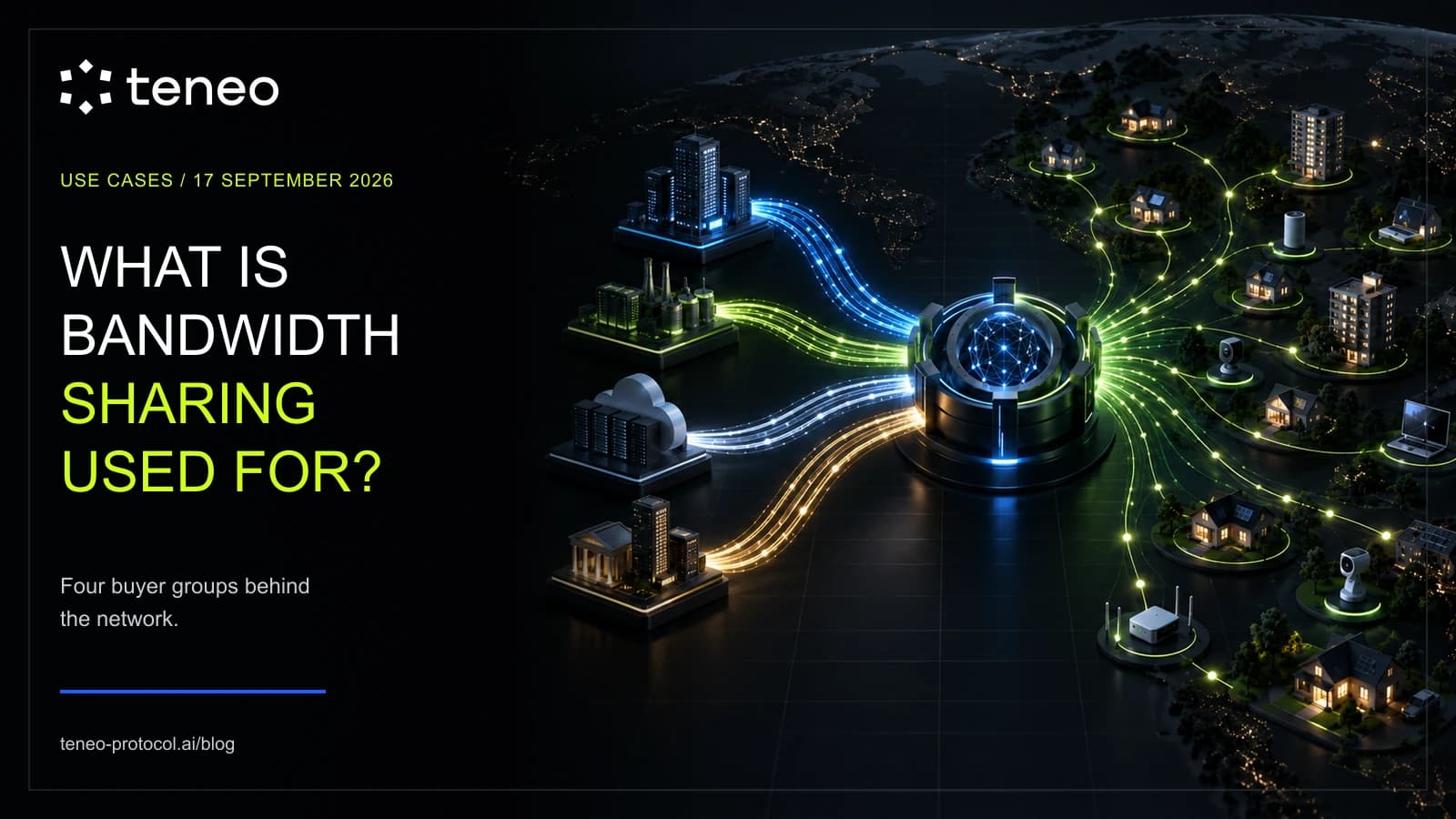
Bandwidth sharing is used to retrieve public web pages through opted-in connections in specific locations. Four common buyer groups are AI search, public data collection, AI training data pipelines and ad verification.
The supply side is straightforward: someone chooses to run an app such as Teneo Beacon and contributes a limited part of an internet connection. On the demand side, a business pays for a public web result that may be difficult to obtain accurately from a cloud data centre. These four groups are useful categories, not a claim that every buyer or request fits neatly into one box.
Why companies use shared bandwidth instead of only cloud servers
The public web can vary by location, device and network. A product may have one price in Dublin and another in Singapore. A search page may rank different results by country. An advert may be sold for a particular city and appear nowhere else.
Data-centre traffic also faces a different set of controls. Sites can rate-limit it, challenge it or block it. Cloudflare's current AI bot controls illustrate the direction: from 15 September 2026, new domains block bots classified as Training or Agent on pages with ads by default, while Search remains allowed. Site owners can change those settings.
A distributed network does not remove a buyer's responsibility to follow applicable law, site terms and data-use permissions. Its practical value is narrower: it can request a public page from the location and connection context the buyer needs.
What are the four main uses of bandwidth sharing?
1. AI search: retrieving fresh pages for an answer
AI search and answer products often retrieve current pages to support a response. A single question can lead to several searches and page fetches, especially when the answer depends on current prices, availability, news or local results.
Shared bandwidth can help a retrieval system request the version of a public page available in a particular market. It does not make the resulting answer correct by itself. The system still has to select trustworthy sources, interpret them accurately and cite them clearly.
2. Public data collection: comparing what the web shows in each market
Price-comparison services, travel aggregators, market researchers, brand-protection teams and search-monitoring tools collect public information at scale. Typical examples include product listings, search results, job adverts, reviews and availability.
Location matters because those results can change by country or city. A buyer may therefore need several independent views of the same public page rather than one response from a central server.
3. AI training data pipelines: sourcing and refreshing permitted public data
Training and evaluation pipelines need broad, current datasets. Shared bandwidth can support the collection or refresh of public material where the buyer has a lawful basis and permission to use it.
That qualification matters. Publicly reachable does not mean unrestricted for every purpose. Collection teams still need controls for copyright, privacy, robots directives, contractual terms, provenance and removal requests. Bandwidth sharing is an access method, not a substitute for data governance.
4. Ad verification: checking the placement a local viewer received
Advertisers buy placements for specific markets, sites, devices and times. Verification teams check whether the advert appeared where it was purchased, whether the surrounding content was suitable and whether the impression was visible.
A request from the target location provides evidence closer to the local viewing conditions. Verification firms can repeat that check across markets and compare the returned page with the campaign agreement.
Why demand for location-specific public web data is growing
Several forces increase the number of useful public-page requests:
- AI assistants and agents retrieve more live information at answer time.
- Websites apply more controls to automated traffic.
- Products operate across more markets, making a single global view less useful.
- Advertisers and marketplaces need independent checks on what users actually receive.
Demand will not rise evenly, and not every request requires a shared connection. Cloud APIs, licensed datasets and direct partnerships remain better options when they provide the required result. Shared bandwidth is valuable when the connection context itself is part of the question.
How Teneo connects buyers with opted-in supply
On the supply side, Teneo Beacon lets an operator opt in and contribute unused internet bandwidth. Operators can stop sharing, and Teneo's current product materials describe the contribution as bandwidth rather than access to private files, messages or browsing activity. The Beacon setup guides explain the supported installation paths.
On the demand side, builders can use Teneo's agent network for public data and other agent services. Published command prices are paid per query in USDC through x402 on supported networks. The Teneo CLI guide and Agent Ecosystem show how that buyer side works.
What should you check before sharing bandwidth?
Bandwidth sharing is not the same as a VPN for your own browsing, and it should not be treated as risk-free by default. Before installing any app, check:
- which traffic the provider permits and blocks;
- whether sharing is opt-in and easy to stop;
- what bandwidth, battery and data limits apply;
- how buyers and prohibited uses are reviewed;
- what activity logs and support channels exist; and
- whether your internet provider or mobile plan restricts this use.
For Teneo, start with the current Beacon product page and terms linked from the site. Product controls and reward mechanics can change, so current documentation is more reliable than an old screenshot or social post.
Frequently asked questions
What is bandwidth sharing?
Bandwidth sharing means opting in to let a network use a limited part of your internet connection for approved requests. In return, the operator may receive rewards under that network's rules.
Who pays for shared bandwidth?
Common buyers include AI search teams retrieving current pages, public data companies comparing listings, AI data pipelines refreshing permitted datasets and ad-verification firms checking local placements.
Why do companies not just use cloud servers?
Cloud servers may receive a different page because websites vary content by location and apply extra controls to data-centre traffic. A shared connection can provide a public-page view from the market being measured.
Does bandwidth sharing slow down my internet?
It can use network capacity, so the effect depends on the app's limits, your connection and current traffic. Check the provider's bandwidth controls and your own data cap before leaving it running.
Is bandwidth sharing safe?
Safety depends on the provider's traffic rules, technical controls and transparency. Use a service that is opt-in, limits permitted requests, explains its data practices and lets you stop sharing at any time.
How do I start sharing bandwidth with Teneo?
Visit the Teneo Beacon page, choose a supported installation path, create an account and follow the setup guide. Review the current terms, bandwidth controls and reward rules before keeping Beacon online.
If you want to contribute network availability, explore Teneo Beacon. If you are building a product that needs current public web data, explore the Teneo Agent Ecosystem.
Key takeaways
- -Bandwidth sharing
- -Beacon
- -DePIN
- -AI search
- -Ad verification