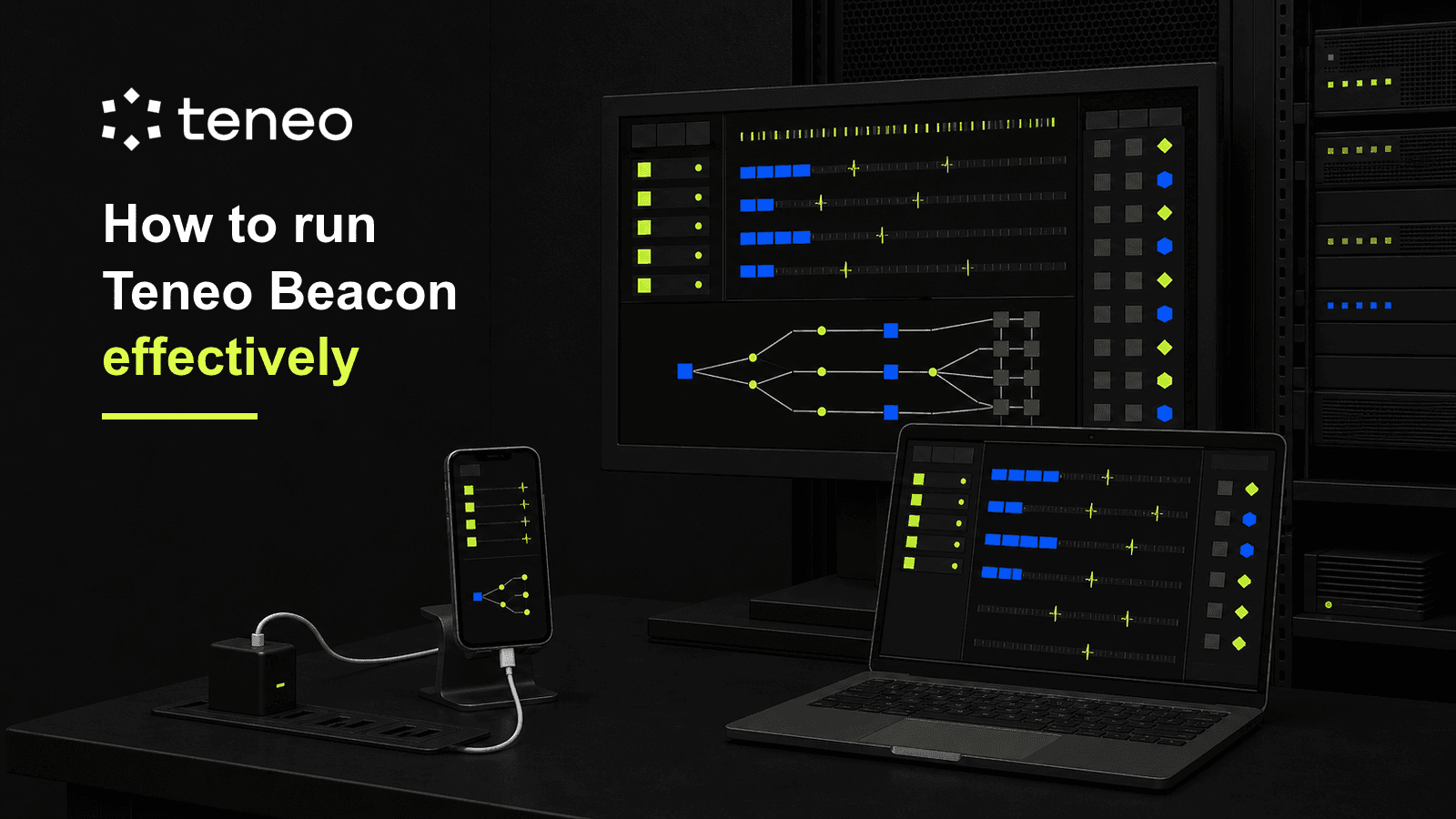
Running Beacon is simple. Running it well comes down to three things: how you set up your devices, how you work the boost cycle, and what you stack on top of a node that is already online.
Running Beacon is simple. Install it, log in, leave it on. Running it well is a different question, and the gap between the two is wider than most people expect.
Beacon earns two things while your device is connected. Teneo Points, the same points the browser extension earned, credited on a heartbeat every 15 minutes. And Fragments, which are exclusive to node operators and accrue at 10 per unique IP per hour. Points tick along on their own. Fragments are where the choices you make actually change the outcome.
This guide is about those choices. Three of them matter: how you set up your devices, how you work the boost cycle, and what you stack on top of a node that is already running. None of it replaces the one thing the network actually pays for, which is a node that stays online. Everything below is a multiplier on uptime, not a substitute for it.
Start with uptime, because everything else multiplies it
Run Beacon overnight while your devices charge
Your phone spends hours every night plugged in and idle. That is ideal Beacon time. The node runs, you are asleep, and nothing you are doing competes with it. On a laptop or desktop the same logic applies: leave it connected overnight and you bank hours you would otherwise lose.
The one platform that needs a small adjustment is iOS, where Beacon has to stay visible to keep running. That is what screensaver mode is for.
Pick the right device to be your always-on anchor
Desktop is the most reliable place to run Beacon, because the desktop app is built to stay out of your way. On Windows it minimizes to the system tray, prevents the machine from sleeping, and starts on boot. macOS does the same and blocks App Nap and idle sleep. Linux minimizes to the tray and autostarts. Set it once and it comes back every time you restart.
Mobile is better as a second or third node than as your only one. Android runs Beacon as a foreground service, so it keeps going with the screen locked. iOS is the strictest: the app has to stay in the foreground, so screensaver mode is how you keep it alive overnight.
If you only run one device, make it a desktop you leave on. If you run several, let a desktop be the anchor that is always up and treat phones as extra nodes.
Run more than one device, on different networks
Fragments are earned per unique IP, at 10 per IP per hour, and devices on different IPs earn independently. A desktop on your home wifi and a phone on cellular are two separate earners. An old laptop you were not using becomes a third.
The detail that trips people up: two devices on the same network share an IP, so they do not stack the way two devices on different IPs do. If you want a second device to add a full independent stream, put it on a different connection.
Work the boost cycle
Uptime fills your unclaimed Fragment balance. Boosting is how you claim it, and more importantly, how you grow the multiplier applied to everything you claim next.
Here is the loop. Fragments accumulate while your node runs. Every 8 hours you can tap Claim and Boost, which banks your unclaimed Fragments and multiplies them by your Beacon Power. Each consecutive boost raises Beacon Power, which starts at 1.00x and climbs to a maximum of 3.00x. Then an 8-hour cooldown, and you do it again.
Boost every 8 hours, and try not to miss the window
Three boosts across a day keeps Beacon Power climbing. Missing a window has a real cost, so protect the multiplier. If you check your phone in the morning, the afternoon, and at night, you are already on roughly the right cadence.
Front-load your first ten boosts
Beacon Power grows fastest at the start. The first 10 boosts add 5 percent each, taking you from 1.00x to 1.50x. After that, each boost adds 2 percent, up to the 3.00x ceiling. The early boosts are the cheapest gains you will ever get, so the first few days of consistency are worth more than the same effort later. Lock the habit in early.
Do not let Fragments pile up to the cap
Unclaimed Fragments are capped at 2,400. Once you hit the ceiling, you stop banking new ones until you claim, so a node that runs for days without a single boost is leaving Fragments on the floor. Boosting on schedule keeps you well under the cap and keeps the multiplier growing. The cap is only a problem if you forget to boost.
Early Claim is a choice, not a habit
You can pay a Fragment fee to skip the cooldown and boost early. The fee scales with how much cooldown is left. It is worth it occasionally, when boosting now compounds your multiplier faster than waiting would, but paying the fee every cycle usually costs more than it returns. Treat the free 8-hour boost as the default and use Early Claim only when the timing genuinely helps.
Stack rewards on top of a running node
Once the node is up and the boost habit is set, everything else is additive. None of the following replaces running a node. It stacks on top of one.
Clear the one-time quests first
Quests are the fastest fixed rewards available. Two are worth doing immediately:
- Link your socials: verify your X and Discord accounts for 100 Fragments each, up to 200.
- Follow us: follow Teneo on X, TikTok, and Instagram for 100 Fragments each, up to 300.
That is up to 500 Fragments for a few minutes of setup, credited once. New quests are added over time and managed server-side, so they can appear without an app update. Check the quest banner at the top of the Beacon dashboard now and then.
Referrals raise your own multiplier, not just theirs
Referrals are the highest-leverage thing you can do, because they pay you in three separate ways.
First, ongoing earnings. You earn 8 percent of every direct referral's Fragments, credited automatically, and 2 percent of what their referrals earn. This is on top of what they earn, never taken out of it.
Second, milestones you hit together. When someone you referred reaches 480 Fragments, which is about two days of uptime, you both get 150 Fragments. When they reach 50,000 Fragments, you both get 2,500. Because you only collect when they succeed, it is worth helping the people you invite actually keep their nodes running.
Third, and most overlooked, a tier multiplier on your own earnings that scales with how many of your referrals stay active:
- 5 activated referrals: 1.2x
- 10 referrals: 1.25x
- 20 referrals: 1.3x
- 50 referrals: 1.6x
- 100 referrals: 1.9x
- 250 or more: 2.5x
That multiplier applies to what you earn, so referrals are not a side activity bolted on. They compound the core loop.
Link your wallet
Binding an EVM wallet to your account through the wallet quest sets you up to receive Beacon Drop payouts and to collect Season tickets. If you skip it, your node still runs, but you are not positioned to receive what running it makes you eligible for. Do it once, early.
Run a real node during Season
Season is a 60-day cycle where consistent, genuine uptime is what counts. The length was extended from 30 days to 60 as a fairness measure. It makes it harder for bot farms to inflate Fragment counts, which protects the operators actually running real hardware.
Part of that system is real-connection verification. The network sends small tasks to confirm a node is a genuine connection and filters out spoofed residential IPs and bots. The takeaway for an honest operator is simple: run Beacon on real devices with real connections and keep them up. You do not need tricks. Consistency on genuine nodes is exactly what Season is built to reward.
Put it together
The order matters more than any single tactic. Get a desktop running as your always-on anchor, then add devices on separate networks. Build the boost habit early, while the multiplier grows fastest, and protect it by not missing windows. Then stack the fixed rewards: clear the quests, invite people and help them stay online, and link your wallet so you can receive what the node earns you.
Everything here points back to the same thing. The network pays for reliable uptime, so the operators who earn the most are not the ones chasing the cleverest trick. They are the ones whose nodes are simply, boringly, always on.
Key takeaways
- -Teneo Beacon
- -node uptime
- -boost cycle
- -Beacon Power
- -referrals
- -Fragments