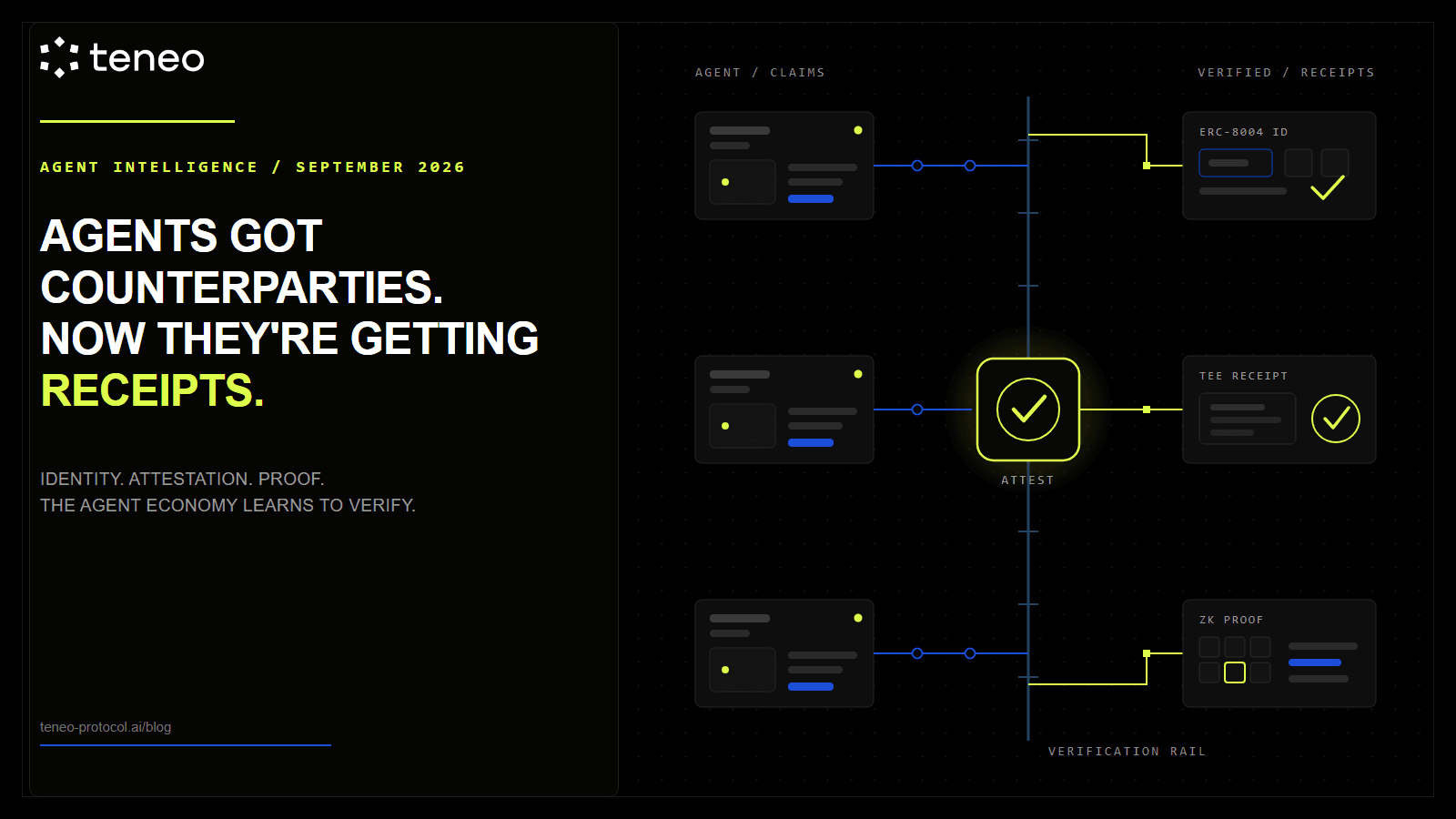
More than 55,000 agents now hold ERC-8004 identities on Base. Phala is serving tens of billions of confidential tokens a day with attestations, Bittensor's proving cluster has passed five billion verified proofs, and Tencent open-sourced a 770B flagship. Identity, proof and open weights arrived in the same fortnight - and verification is where the scarcity moved.
Last month's round-up ended on a question: once everyone agrees the agent economy exists, who is actually on the other side of the trade? The fortnight since has been quietly answering a harder one. Before agents can transact at scale, three unglamorous things have to exist: an identity you can look up, proof of what actually ran, and a cost floor low enough that checking the work does not cost more than doing it.
The news since then is those three things arriving at once.
Agents are registering like citizens
ERC-8004, titled "Trustless Agents", is a standard for giving an agent a portable on-chain identity: an ERC-721 handle that resolves to a registration file listing the agent's endpoints - MCP, A2A, wallets - plus a reputation registry for feedback and a validation registry for independent checks. The authors sit at MetaMask, the Ethereum Foundation, Google and Coinbase, which is a reasonable proxy for how seriously the idea is being taken.
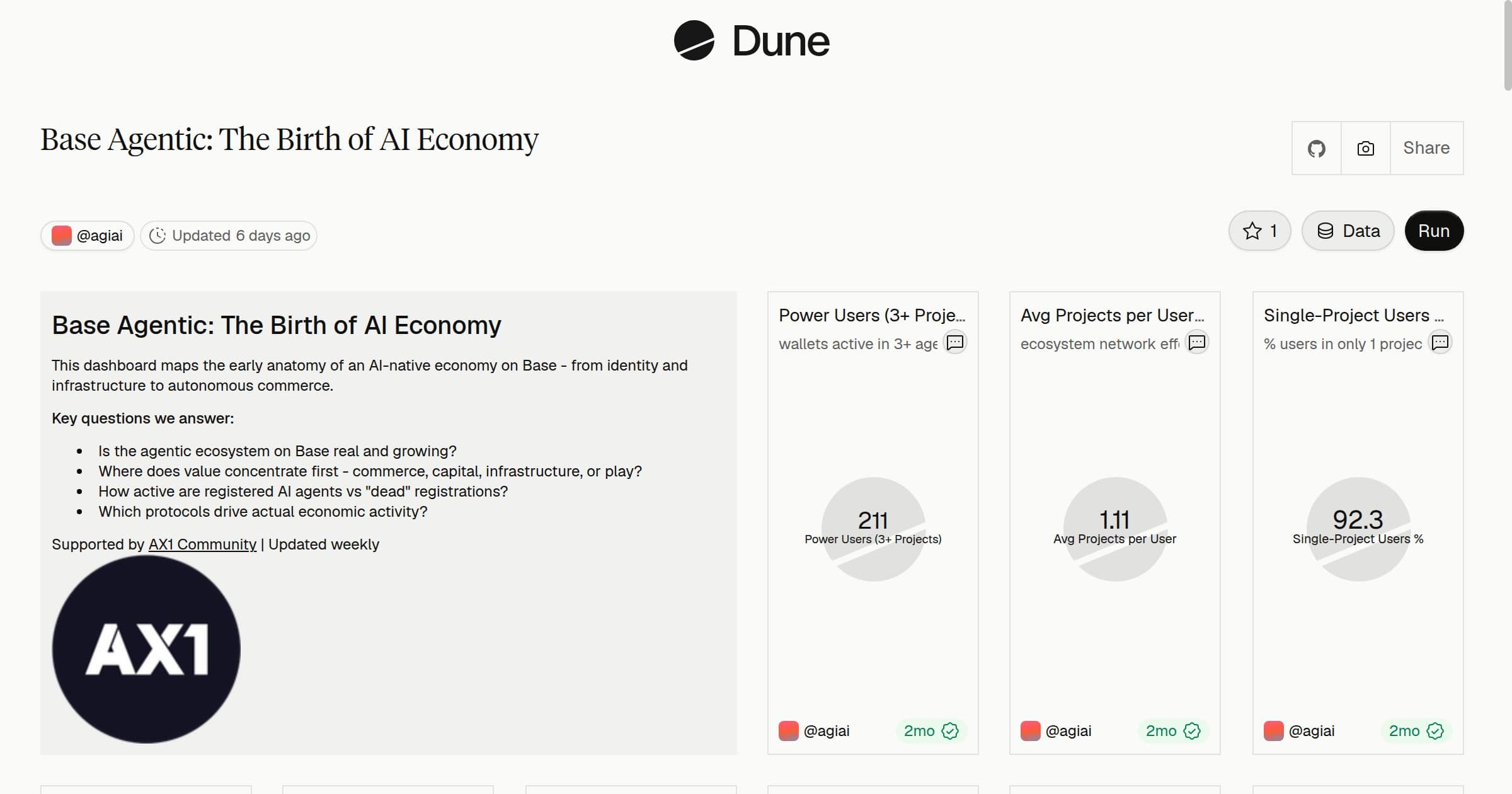
It is not a paper standard. Dune's Base Agentic dashboard counts more than 55,000 agents registered under ERC-8004 on Base alone, inside an ecosystem tracking over 215,000 unique addresses and 1.2 million transactions this year.
The detail worth reading twice is the trust section. The standard makes trust models pluggable and proportional to the value at risk: client reputation for ordering pizza, stake-secured re-execution, zkML proofs or TEE attestation for anything that matters. And when the spec wants an example of hardening a feedback record, it reaches for an x402 proof of payment. Identity, reputation and settlement are converging on the same open rails we already build on.
Inference is growing a paper trail
If a registry answers "who is this agent", the next question is "did it actually run what it claims". That question stopped being academic this month.
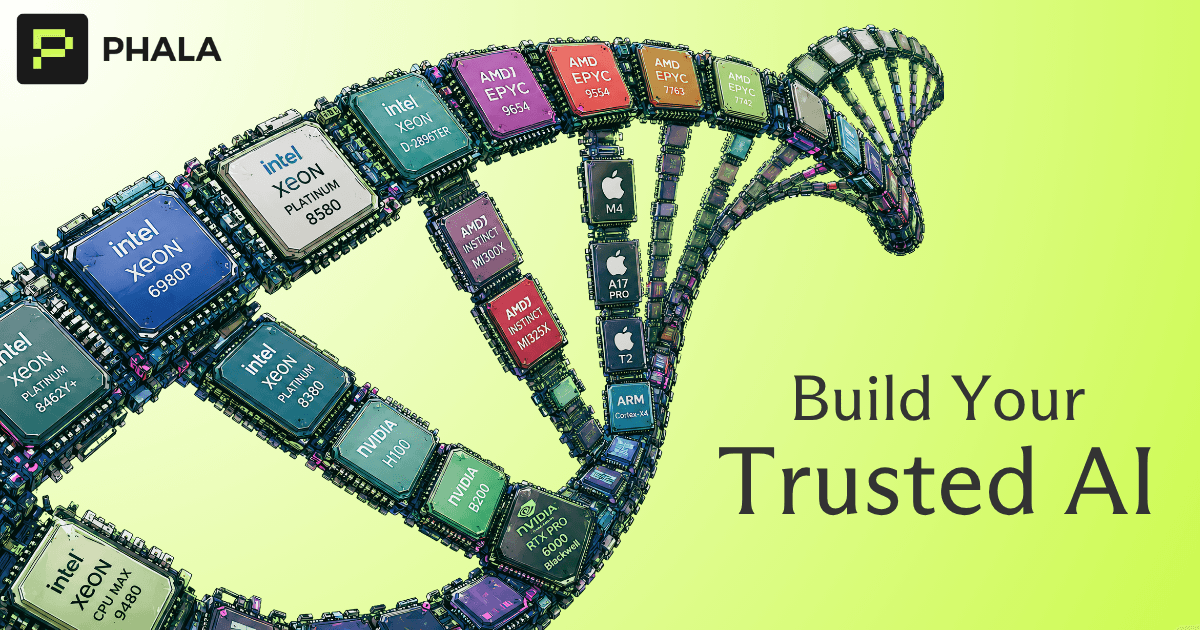
Phala serves open-weight models inside GPU trusted execution environments: prompts stay private, and every call can return a hardware-backed attestation of exactly what ran. The live counter on its homepage showed roughly 43 billion confidential model tokens served in a single day at the end of August. Whatever the daily swing, private inference with receipts is no longer a lab demo. It is a commodity product with real traffic, priced per token like any other route.
That matters for one kind of buyer immediately: agents handling client data. A legal, medical or financial workflow can now buy inference that comes with proof of confidentiality, at ordinary prices. The demand pull moves from token tickers to attestation receipts.
Proof is becoming a market
The cryptographic route to the same destination is further along than most people think. Inference Labs' Subnet 2 on Bittensor compiles AI models into zero-knowledge circuits, so an inference arrives with a mathematical proof that it happened. The live dashboard shows 5.7 billion proofs verified across roughly 1,700 miners and 27 validators - and the miners are scored on proof size, latency and accuracy, not just on answers.
That scoring detail is the story. When provers compete on the cost and speed of proofs, proving stops being a research artefact and becomes a priced service. The same week, another Bittensor team published its design for hardware attestation of GPU claims, with audit moments derived from block hashes so neither miner nor validator can choose when they get inspected. Cheap "I have an H100" claims are on their way out.
Read the last two sections together. "Trust me" is being replaced by "check the receipt", and both the hardware route and the mathematical route now run at production volume.
The frontier went open, and the floor fell out
None of that verification volume happens if running a capable model stays expensive, which is why the open-weights news this fortnight belongs in the same piece.
Tencent shipped Hy4 preview: a 770B-parameter Mixture-of-Experts flagship with 49B active per token, a 1M context window and Apache 2.0 weights, with vLLM and SGLang images published the same day. In Tencent's internal blind test, 163 experts across 203 engineering tasks rated it slightly ahead of both GLM-5.2's successor and Kimi K3. Z.ai's GLM-5.3 weights landed on Hugging Face days earlier and were downloaded over 90,000 times in their first weeks. And at the other end of the scale, a Tsinghua team published Puro-2B: a 2B model pretrained from scratch on 1.4 trillion tokens using consumer RTX 5090s, for a compute cost under $6,900, approaching Qwen2.5-1.5B under the authors' protocol - recipe, data, code and weights all Apache 2.0.
Frontier-class capability is now downloadable, and small-model pretraining costs less than the laptop it was written up on. Which is exactly why receipts are the theme. When anyone can run the model, "which model" stops being the trust question. What actually ran, on whose hardware, against what data - that is where the differentiation, and the value, moved.
The constraint did not move
The physical layer, meanwhile, printed its number. NVIDIA reported $96.2 billion in quarterly revenue, up 106% year on year, with data centre revenue at $89.0 billion and a $108 billion guide for next quarter - and it still describes itself as supply-constrained. The same week, The Information reported that NVIDIA has agreed to buy Hugging Face for $12.9 billion. Neither company has confirmed it. But read next to Stripe's move on OpenRouter last month, the shape is familiar: the layer with the pricing power keeps buying the layer where distribution happens.
The lesson we keep returning to holds at every altitude. Value migrates to whatever cannot be conjured with capital on short notice. Compute has power and memory. Models are copyable - the section above is the proof. Agents have live data, and now they have verifiable claims. An honest, distributed view of the open web remains the input you cannot spin up in a data centre.
That is the position we occupy, and this fortnight's theme is the reason the network is built the way it is. Season 3 ran connection verification against every Beacon for sixty days for the same reason ERC-8004 ships a validation registry and Phala returns attestations: an agent economy runs on claims that can be checked. Hundreds of live agents on the protocol, paid per call in USDC over x402 across PEAQ, Base, Avalanche and X Layer, on top of a bandwidth network whose supply is verified rather than assumed.
Start with Beacon, or start calling agents. Both begin at teneo-protocol.ai.
Key takeaways
- -Agent economy
- -Verification
- -DeAI
- -Open weights
- -Market signal