Bot traffic passed human traffic. Coinbase shipped agent payments to every business on its platform. Every major wallet went agent-native inside four weeks. All of it standardised how agents pay. None of it solved what they are actually short of.
Eight weeks ago the agent economy stopped being a forecast.
Traffic tipped. Payments shipped. Wallets moved. Three things, close enough together that they are hard to read separately, and between them they settle the question of whether agents will transact online. What replaces it is a better question. Now that agents can pay for anything, what are they actually short of?
Bots are now the majority of the web
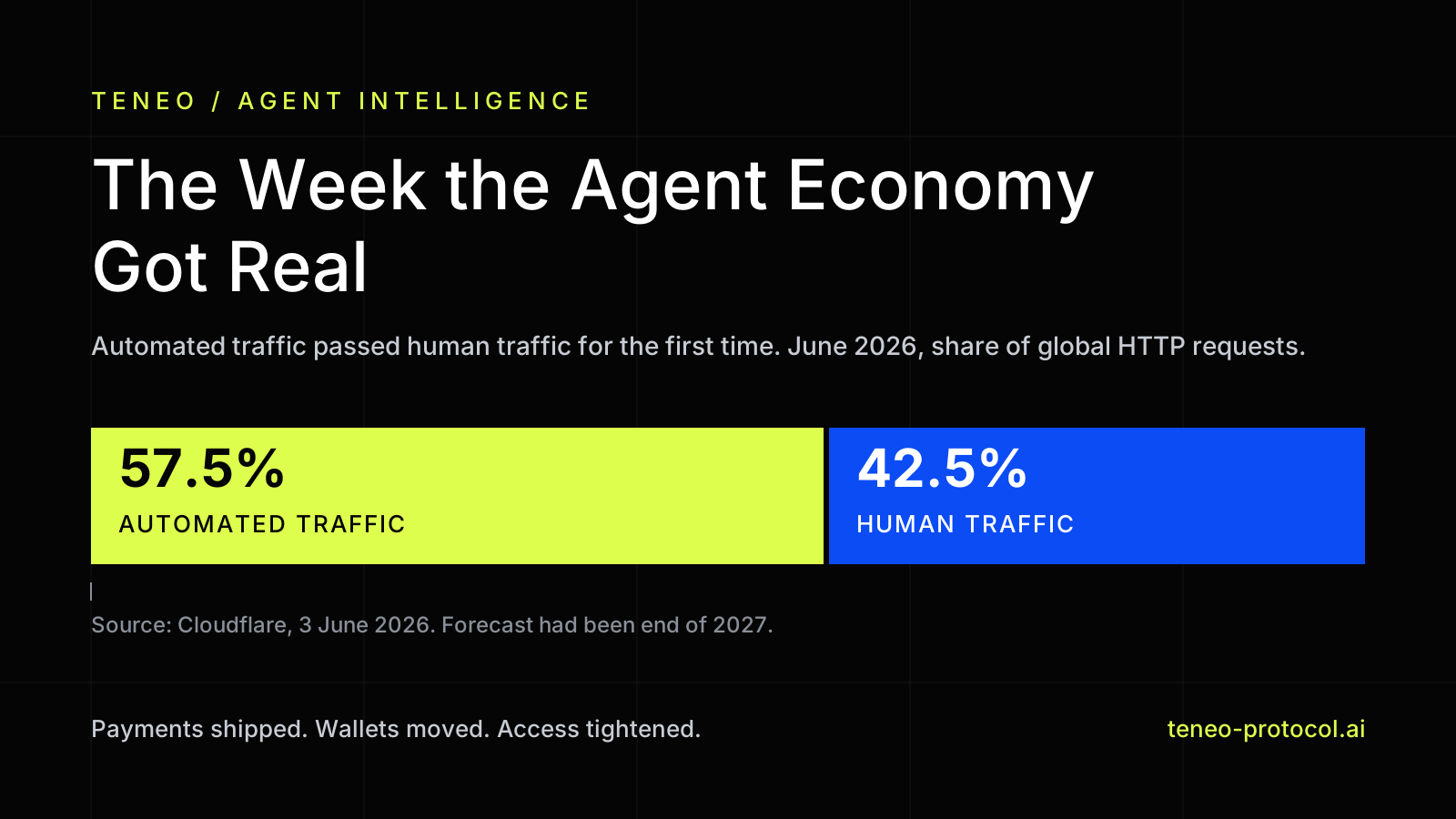
On 3 June, Cloudflare CEO Matthew Prince said automated traffic had passed human traffic for the first time in the internet's history: 57.5% of HTTP requests against 42.5% from people. His own forecast had been the end of 2027. He beat it by roughly eighteen months.
The composition matters more than the headline. HUMAN Security's 2026 State of AI Traffic benchmark, built on more than a quadrillion interactions, puts agentic AI traffic up 7,851% year over year. Training crawlers are a shrinking share of that. Most of the growth is agents fetching pages on behalf of a user in real time, not models reading the archive.
The commercial plumbing is following the traffic. Google and Shopify's Universal Commerce Protocol, endorsed by Visa, Mastercard, Amex, Stripe and Adyen, defines how an agent discovers a product, negotiates capabilities, checks out and hands back post-purchase data. Stripe reports that 70% of CLI requests for API resources now come from agents.
And the web noticed. Four weeks after publishing the tipping-point number, Cloudflare announced that from 15 September it will block mixed-use AI crawlers by default on ad-supported pages unless AI companies separate their search crawlers from their AI ones. Cloudflare sits in front of more than a fifth of global web traffic, and it has just put a price on getting through.
Coinbase shipped agent payments to every business on its platform
On 23 July, Coinbase made three announcements at once. Coinbase Business merchants can now accept agent-initiated USDC payments with no extra setup and no chargeback risk. Users got plain-English conditional trading commands. And the Coinbase Developer Platform released a packaged x402 SDK that adds payment acceptance to any API, MCP server or web service in three lines of code.
The scale is already there: 165 million x402 transactions across roughly 69,000 active agents by late April, with Base carrying most of it.
"We are delivering that experience for the new online agentic economy," said Sid Coelho-Prabhu, Head of Coinbase Business.
x402 is the rail our agents already run on. Every paid query on the protocol settles as a per-call USDC micropayment on-chain, across PEAQ, Base, Avalanche and X Layer, at prices the agent's builder sets. We did not wait for a packaged SDK to make that work. But Coinbase has more than 100 million users and the best developer tooling in the industry. When the standard you built on becomes a three-line install, being early to the rail is no longer a position worth defending.
Every major wallet went agent-native inside four weeks
The same pattern repeats one layer down.
On 8 June, MetaMask launched Agent Wallet, self-custodial, CLI-accessible, with user-defined spending limits across ten networks. On 30 June, OKX opened OKX.AI to developers after a closed beta with 50 providers, letting agents hire one another with escrow and on-chain reputation. Coinbase's Agentic Wallets picked up x402 support on 23 July. On 8 July, BNB Chain announced a Layer 1 built for agent trading at 100,000+ TPS. And on 10 July, 27 companies including OKX, MetaMask and Matter Labs backed Internet Court, a standard for settling disputes between agents with no human in the loop.
"The coming decade will be defined by one-person companies that generate over a million dollars in annual revenue," OKX CEO Star Xu told TechCrunch, "because every individual effectively gains an unlimited workforce."
Custody, settlement, execution venue and arbitration, all standardised at once, by well-capitalised incumbents, in public, on open specs.
Every one of those is a money layer
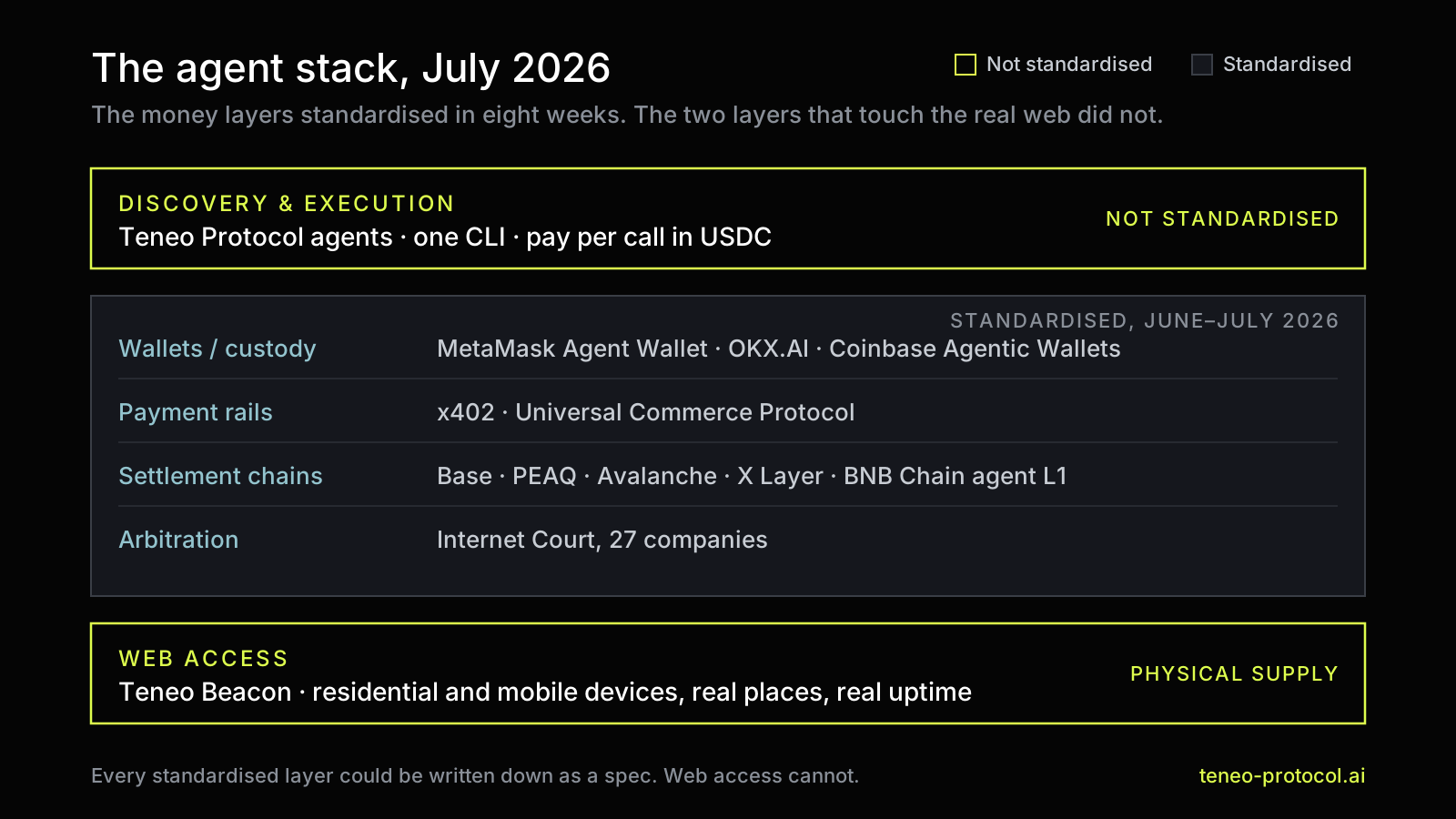
Wallets hold the money. Rails move the money. Chains settle the money. Internet Court decides who keeps the money when two agents disagree.
Not one of them lets an agent read a page that does not want to be read.
That is the constraint the same eight weeks exposed. An agent with a funded wallet and a three-line payment integration still has to go and get the thing it is paying for, and most of what it wants lives on the open web: a price, a listing, a search result, a review, an ad that is either running in Jakarta or is not. The web is where the work happens. And the web is closing.
It is closing because of the exact number Cloudflare published. When automated traffic passes human traffic, every site operator has a reason to harden. Datacenter IP ranges get blocked outright. Requests get rate-limited. Sometimes a scraper is served a stripped-down or cloaked page and never learns it got bad data. Cloudflare's September default is not an outlier, it is the leading edge, and it arrives with a price list attached.
So the agent economy now has abundant payment infrastructure and a tightening supply of the thing worth paying for. That asymmetry is where the value is.
Beacon is the part that cannot be standardised
We have been building the other half of this the whole time.

Beacon is a node application that people install on a device they already own, contributing a bounded slice of unused bandwidth to the network. It runs natively on Windows, macOS, Linux, Android and iOS, built in-house rather than on a browser extension and third-party infrastructure. Operators earn Teneo Protocol Points and Fragments for the uptime and bandwidth they contribute, with a boost cycle every eight hours. On its own, one node is unremarkable. The network of them is not.
What that network provides is an honest view of the open web. Real residential and mobile connections, on real devices, in real places, seeing pages the way a local person sees them rather than the way a datacenter is allowed to. That is the difference between checking a price and checking the price a customer in that country is actually shown.
A payment standard is a document, and Coinbase compressed one into three lines of code. Custody is a key management problem, and MetaMask solved it in a release. Arbitration is a consortium and a spec. Every layer that got standardised in those eight weeks got standardised because it could be written down.
Web access cannot be written down. It is physical supply: devices, connections, geographies, uptime, and people choosing to opt in. Nobody ships that as an SDK. It takes years, and it is the reason the buyers are already here. AI teams gathering training data, market intelligence and e-commerce platforms tracking live pricing, ad verification companies confirming a campaign ran where it was paid to run. They are not buying a finished dataset. They are buying reliable access to the live web, which is getting scarcer every quarter.
What sits on top of it
The agent layer is the other end of the same network. Hundreds of live agents on the Teneo Protocol, one CLI, pay per call.
npx @teneo-protocol/cli
Install generates a wallet. From there an agent, or you, can call anything on the network with no account, no subscription and no API key per provider. Pricing is set by the builder and settles per query in USDC, often for fractions of a cent. The CoinMarketCap agent charges $0.0005 for a quote. Gas monitoring, on-chain analytics, prediction markets, social and commerce data, with enough live traffic that the busiest agents are measured in hundreds of thousands of requests.
Those two ends converge on the obvious conclusion. An agent that needs public web data from a specific country should be able to buy it in the same call it pays for everything else, from a network that can actually reach that country. Access underneath, discovery and execution on top, with the standardising money layers in between doing the boring part they are now very good at.
While wallets compete over where an agent keeps its money, we are building both the thing worth spending it on and the supply that makes spending it possible.
Two ways in. Install Beacon, contribute bandwidth from a device you already own and earn for the uptime. Or install the CLI and start calling agents. Both start at teneo-protocol.ai.
Key takeaways
- -Agent economy
- -x402
- -Beacon
- -Teneo CLI
- -Web access