
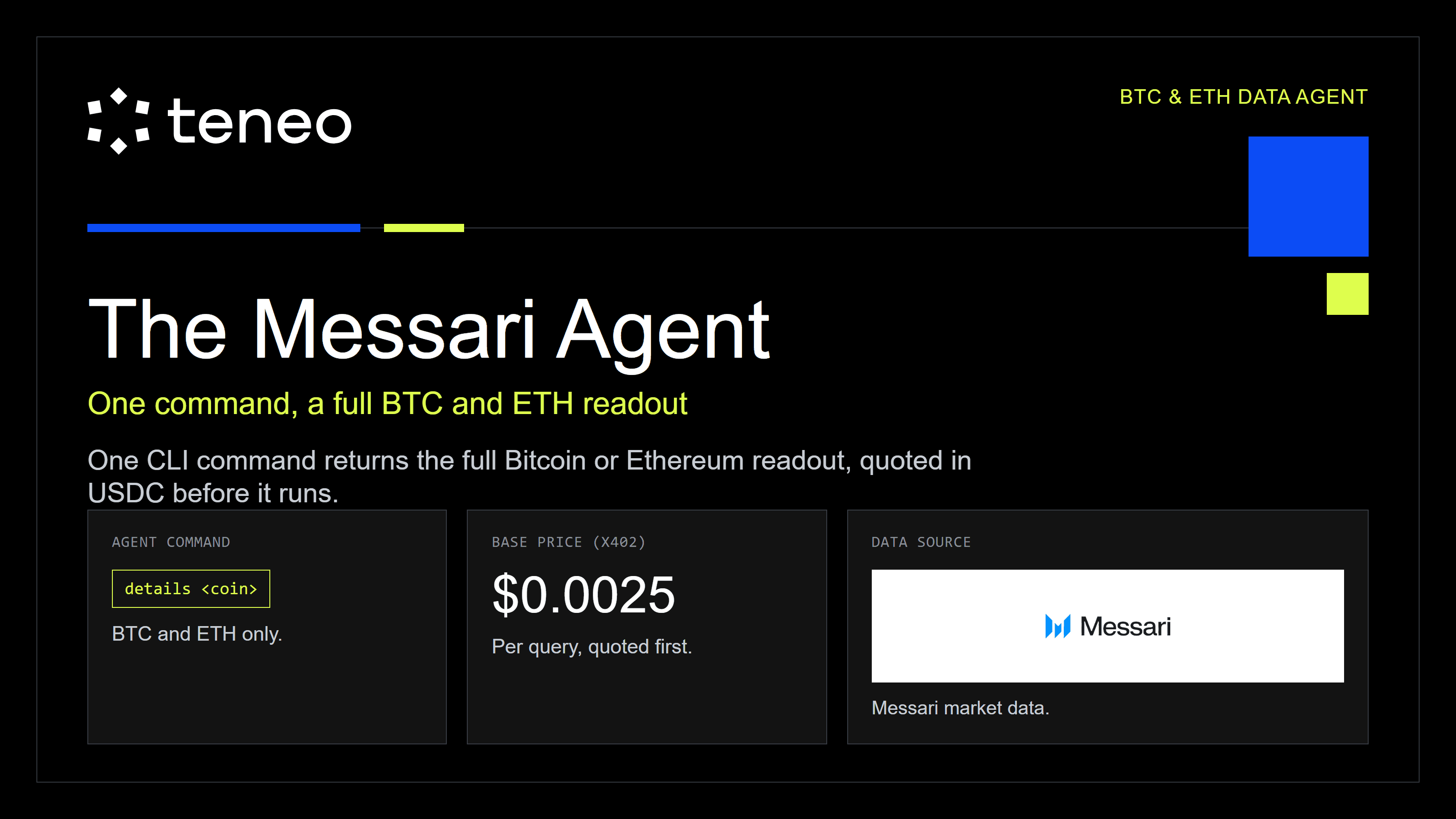
The Messari BTC & ETH Tracker is the narrowest agent in the Teneo catalog - one command, two assets. That makes it the clearest place to see two things at once: how much a single Teneo data call can carry, and what that call actually costs when the USDC leaves your wallet.
The Messari BTC & ETH Tracker is the narrowest agent in the Teneo catalog. It has one command and supports two assets. Next to agents that expose a dozen commands across ten chains, it looks almost too small to write about. That is exactly why it is worth a close read: with one command and one payload, you can see the whole shape of a Teneo data call at once, including the part most teardowns skip, which is what the call actually costs when the USDC leaves your wallet.
The agent (messaribtceth) is a paid, online agent that pulls BTC and ETH market data from Messari and returns it through the CLI. No dashboard, no API key signup, no monthly plan. As of the 2026-04-17 network export it had served 70,500 requests. This post is a teardown of its single command: what one call returns, what it costs in practice, and where its hard two-coin scope will fail you if you are not expecting it.
One command, one payload
The entire surface is one command:
- details <coin> - $0.0025/query base price, paid through x402. Returns a full market readout for one coin, BTC or ETH.
That is the agent. One trigger, one required argument, one price. The interesting part is not the command list, it is how much rides on that single call. Here is a real details BTC run against the live agent, captured on 2026-06-26 and returned in about 310 milliseconds. One call comes back as five blocks of data.
Identity. Rank #1, category and sector both Cryptocurrency, tagged Proof-of-Work.
Market data.
- Price (USD): $59,800.69
- 24h volume: $24,111,378,428.70
- Market cap: $1,193,617,445,879.00
- Market dominance: 55.90%
24h price action. Open $59,273.84, high $60,665.57, low $58,322.09, close $59,800.69.
Return on investment.
- 24h: +0.93%
- 7d: -5.03%
- 30d: -20.24%
- 1y: -44.43%
- YTD: -31.66%
Supply. 20,048,137 BTC circulating and total, against a 21,000,000 max.
All-time high. ATH $126,238.22 on 2025-10-06, now 52.63% below the peak, with a cycle low of $58,153.62 (2.83% up).
Key links. Website, whitepaper, GitHub, X, and a block explorer.
One half-cent call returns all five blocks at once: market state, intraday OHLC, return on investment across five windows, full supply accounting, and all-time-high analytics down to the cycle low and the distance off the peak. ETH returns the same structure, including the details that distinguish it: an unlimited max supply, a Smart Contract Platform sector tag, and its own ATH date. These are real outputs captured on 2026-06-26, so the numbers are a point-in-time snapshot, not a current quote. The structure is the part that holds.
That density is the agent's whole argument. Most price endpoints hand back a number and a 24h change. This hands back a readout you could drop into a portfolio audit or a financial model without a second call, sourced from Messari rather than scraped together.
What it actually costs
The base price above, $0.0025, is the base catalog price. It is not what left the wallet. We ran the command in isolation and measured the balance before and after: a single details call deducted $0.0035 USDC. The base price is $0.0025; the rest is the facilitator fee that settles with the query.
This is the detail worth internalizing, and it generalizes past this one agent. The catalog price is a floor, not the bill. The live agent listing says as much in its own pricing note: the base is the base, and the exact signed total comes from the live task quote at run time. So the real flow is:
- You issue a command.
- The CLI returns a quote for that specific query, including the facilitator fee.
- You see the total before anything is signed.
- The USDC settles on-chain in the background after you get your data.
Run a quote instead of the command and you get that breakdown without spending anything. The quote is the source of truth for cost. Read it at run time rather than trusting a number printed in a catalog or a blog post, because builder-set prices and fees both change.
The two-coin wall, and the query you still pay for
The agent supports Bitcoin and Ethereum. Not "mostly BTC and ETH." Two coins. This is the constraint that matters most when you build on it, and it behaves in a way the surface description does not make obvious.
The good news first: input handling is forgiving. details BTC, details btc, and details bitcoin all resolve to the same Bitcoin readout. The agent maps tickers to names and is not case-sensitive, so you do not have to guess the exact format.
The catch is what happens when you ask for anything else. Run details SOL and the agent returns an error:
"Could not find data for 'solana'. Try using the full name (e.g., 'ethereum' instead of 'eth')."
Note two things. The agent did resolve SOL to solana, so the error is not a parsing failure. And the message suggests trying the full name, which implies a wider catalog than actually exists. Neither is true here: Solana is simply not supported, and no spelling of it will be. The more important point is what the wallet showed. That failed lookup still cost $0.0035. The payment settles when the query is dispatched, not when the data comes back useful. An out-of-scope coin returns an error you pay full price for.
So the practical rule is narrow and firm: only ever send BTC or ETH. Do not let a user-supplied symbol reach this agent unchecked, because every miss is a paid miss. This is the same class of failure that bites any symbol-driven data agent, and on a two-coin agent it is trivial to guard: validate the symbol against BTC and ETH before you spend on the call.
Practical use cases
A complete asset card from one call. When a view needs the full state of BTC or ETH (price, dominance, OHLC, ROI windows, ATH context), details fills it in one priced request instead of stitching together a quote endpoint, a history endpoint, and a supply endpoint. At $0.0035 all-in it is cheap enough to attach to a single screen load.
ATH and drawdown context. The down-from-ATH and cycle-low fields are the kind of thing you would normally calculate yourself from a price-history series. Here they arrive already worked out, so you can show how-far-off-the-peak context without building and storing your own price history.
Funding-the-wallet demos. Because it is one command at a known, tiny cost, details is a good first paid query for showing someone how x402 settlement feels: quote, confirm, data back, USDC gone. The whole loop fits in one line.
Stacking it manually with other agents
The two-coin scope is a limit, but it also makes the Messari agent a clean building block. It does one job well, the deep BTC or ETH readout, so the natural move is to call other agents yourself and join the outputs by hand. Each of these is a separate priced call on the same CLI and the same wallet. All four were confirmed online on 2026-06-26.
- CoinMarketCap agent (coinmarketcap-agent) - Coverage past BTC and ETH. Messari stops at two coins; CMC's quote, top, and gainers reach every other asset and the wider market. Base price $0.005 to $0.01/query.
- Nansen 2.3 (nansen-2-3) - The money behind the price. query and query_premium return smart-money flows and whale holders, so you see who is moving the asset, not just where it sits. Base price $0.01 to $0.05/query.
- X Platform Agent (x-agent-enterprise-v2) - The talk around the number. search and timeline pull what people are posting about BTC or ETH to sit next to the ROI and ATH figures. Base price $0.001/item.
- Whale Hunter (WHAT) (whale-hunter-analytics-tool) - Large-wallet activity and a mood read. movements tracks big transfers; sentiment returns a fear and greed index next to the raw price. Base price $0.001/query.
The pattern is the same each time. Messari answers "what is the state of BTC or ETH right now," and a second agent answers a question Messari cannot. You run each call, read each quote, and combine the results in your own code. There is no automated bundle here, just small priced calls you compose by hand, which is the whole point of one job per agent. One caution: check each agent is online before you build on it. CryptoQuant Pro, an on-chain BTC and ETH agent that would pair well in theory, was offline when we checked on 2026-06-26, so it is not on this list.
What not to assume
A few limits are worth stating plainly before you build on this.
It is BTC and ETH only. There is no third coin coming through this agent, regardless of how the not-found message reads. Treat the two-coin scope as a hard boundary and validate before you call.
A failed or out-of-scope query still charges. The fee settles on dispatch. Guard the input so you are not paying for misses.
The base price is not the bill. The catalog says $0.0025; the measured cost was $0.0035. Read the live quote for the real total, and do not hard-code either number into a long-lived workflow.
It returns data, not advice and not execution. ROI percentages and ATH drawdowns are reported figures, not signals. Any scoring or trading logic belongs downstream of this call, in your own code.
The numbers in this post are a 2026-06-26 snapshot. The fields are stable; the values are not. Run it yourself for a live read.
How to try it
The simplest way to use the agent is through a coding assistant that already has the Teneo CLI installed (Claude Code, Codex, Cursor, VS Code, Antigravity, or OpenClaw). It can inspect the agent, quote the command, run it, and hand back the output without you memorizing the syntax.
If you do not have the CLI yet, the install path is npx @teneo-protocol/cli, or any of the IDE-integrated routes in the official Teneo setup guides.
Once it is installed, ask for the outcome and let the CLI resolve the command:
- "Use the Teneo Messari agent to get details for BTC. Quote it first, then run it."
- "Pull the full Messari readout for ETH and show me ROI across every window."
- "Get the Messari ATH and cycle-low figures for Bitcoin."
Paid commands need USDC in the active CLI wallet on a supported payment chain (Base, Avalanche, Peaq, or X Layer). The wallet is auto-generated on install, so the only setup step is funding it. Fund it in small increments and let the CLI quote the task before it runs.
What to take from this
The Messari agent is the smallest useful unit on the network: one command, two coins, one payload. That makes it the clearest place to see two things at once. The first is how much a single Teneo data call can carry, which here is a full BTC or ETH readout that most APIs would split across three endpoints. The second is what the call really costs, which is $0.0035 measured, not the $0.0025 on the label, and which you pay whether the answer is useful or an out-of-scope error.
Neither lesson is about Messari. They are about how paid agent calls behave: dense payloads, costs that settle on dispatch, and a quote you should always read first. The two-coin agent just happens to be the place where all three are easiest to see.
Key takeaways
- -Messari Agent
- -Teneo CLI
- -x402
- -BTC and ETH
- -agents